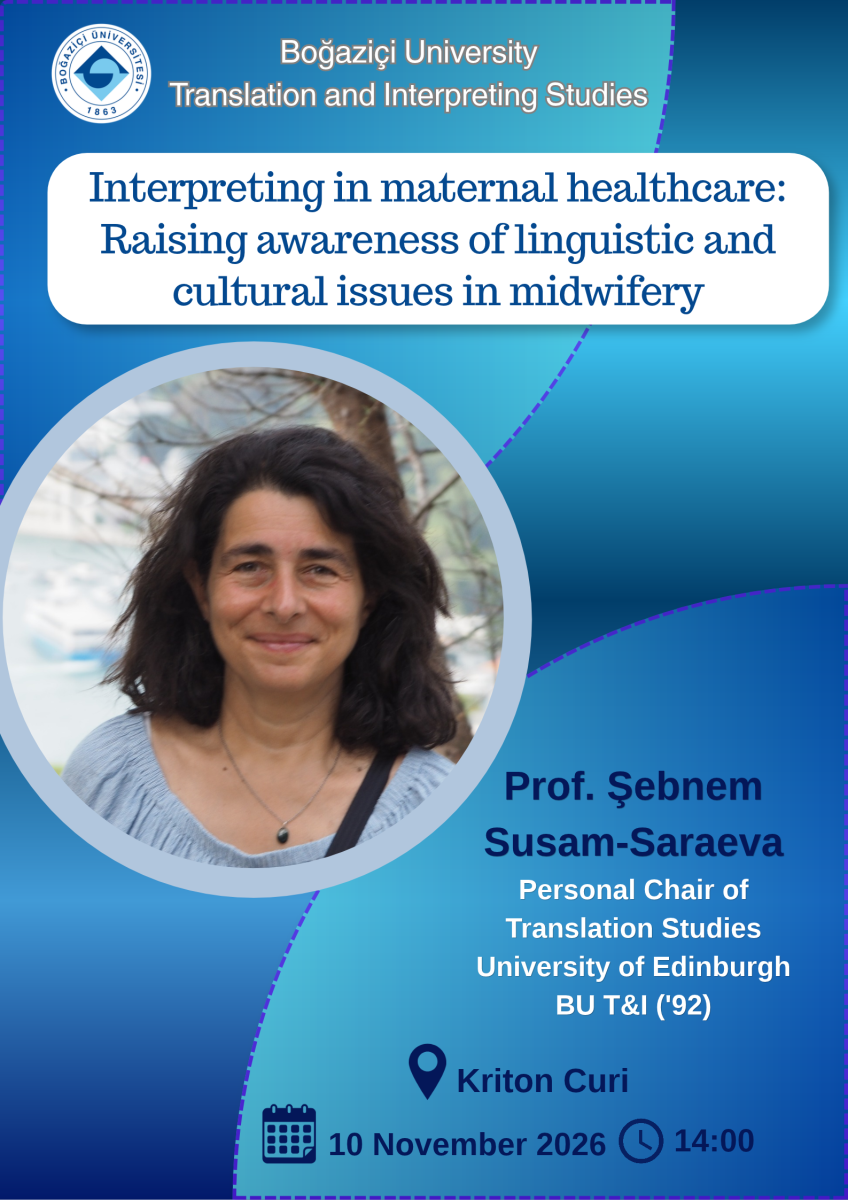





Guest lecture by Şebnem Susam-Saraeva

The Department of Translation and Interpreting Studies at Boğaziçi University cordially invites you to a lecture by Dr. Şebnem Susam-Saraeva (University of Edinburgh) on “Interpreting in maternal healthcare: Raising awareness of linguistic and cultural issues in midwifery”. The lecture will be held on 10 November 2026, at 14:00 in the Kriton Curi Seminar Room.
Şebnem Susam-Saraeva graduated from the Department of Translation and Interpreting Studies in Boğaziçi in 1992 and now holds a Personal Chair in Translation Studies at the University of Edinburgh, Scotland, U.K. Her past research included translation of literary theories, retranslations, research methodology in translation studies, internationalisation of the discipline, non-professionals translating/interpreting, translation and gender, translation and popular music, and ethical & representational issues in translation. Her recent work focuses on translation/interpreting in maternal health and on eco-translation, particularly interspecies communication. She is the author of Translation and Popular Music. Transcultural Intimacy in Turkish-Greek Relations (2015) and Theories on the Move. Translation’s Role in the Travels of Literary Theories (2006), and editor of Translation and Music (2008), Non-Professionals Translating and Interpreting. Participatory and Engaged Perspectives (2012, with Luis Pérez-González) and Routledge Handbook of Translation and Health (2021, with Eva Spišiaková). Susam-Saraeva’s literary translations into Turkish include Kazuo Ishiguro’s The Remains of the Day (1993, 24 reprints by 2025). She is also the winner of the PEN Wales Translation Challenge 2017 with her poetry translation from Küçük İskender.
Interpreting in maternal healthcare: Raising awareness of linguistic and cultural issues in midwifery
‘Language barriers’ are one of the key factors contributing to poorer outcomes in maternal and neonatal health in families with immigrant, refugee or asylum-seeking status, increasing mortality and morbidity rates both for mothers and babies. However, there is often very little provision in midwifery education to raise awareness of linguistic and cultural issues, and to increase midwives’ knowledge about how to work with interpreters.
The talk will provide information on the findings of two research projects funded by the Royal Society of Edinburgh, Scotland, where we explored ways of accentuating language needs and thus streamlining access to interpreting services throughout the perinatal period. The projects established a collaborative network of researchers, practitioners and educators in order to examine the best ways of flagging up interpreting needs at early stages of antenatal care and of firmly incorporating linguistic and cultural awareness into midwifery curricula in Scotland. The talk will also give examples from the cross-professional workshops we carried out between 2022 and 2026, and the feedback received during and after these workshops.